
Content Strategist Resume (2026): Show Strategic Impact, Not Just Tasks
Written by Armen Mkhitaryan
This guide focuses on making your Content Strategist resume show measurable impact, governance experience, and portfolio evidence recruiters value in 2026.
Hiring-manager brief and TL;DR checklist
Hiring-manager brief
Hiring teams look for clear ownership of content programs, measurable outcomes that link to business goals, and evidence you can scale content through governance and operations.
TL;DR checklist
- Lead with 2-4 measurable achievements
- Include a concise strategy summary (what you own, who you influence, scale)
- Name tools and CMS, include traffic/engagement/efficiency metrics
- Link to 1-3 portfolio case studies (one-pager format)
- Prioritize impact statements over task lists
Persona to anchor examples
Mid-level Content Strategist at a B2B SaaS company, 4-6 years experience, focuses on SEO-led product content, works across product and marketing teams.
What hiring teams look for in 2026
High-level hiring patterns
- Evidence of production ownership and measurable improvements
- Ability to turn research into prioritization frameworks and roadmaps
- Experience with content operations and governance for scale
- Clear examples of cross-functional influence (product, UX, engineering, SEO)
Evaluation criteria recruiters use
- Scope: channels, monthly traffic, team size, revenue influence
- Deliverables: audits, taxonomies, governance docs, playbooks
- Tools: CMS, analytics, SEO suites, dashboards
- Outcomes: traffic lift, conversion improvements, production efficiency gains
Red flags
- Task-only bullets with no outcomes
- No portfolio or broken links
- Vague metrics (no baseline or timeframe)
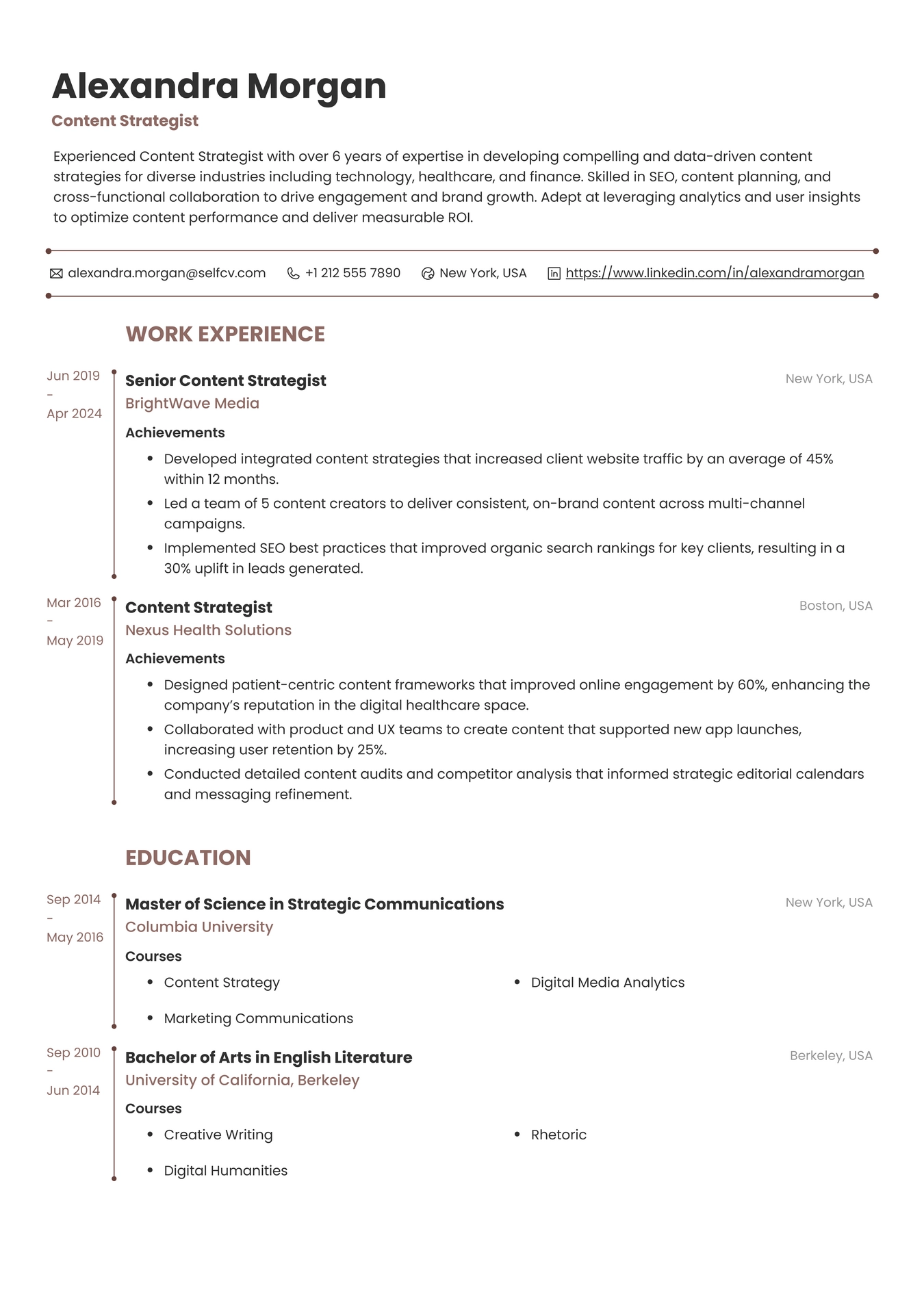
Resume Example for Content Strategist
Resume structure and section priorities
Recommended order (prioritize impact)
- Header: name, location, contact, portfolio link
- Professional summary: 1-2 lines focused on strategy scope and outcomes
- Selected achievements: 2-4 bullets with metrics and context
- Experience: project-focused bullets with contributions and results
- Skills & tools: grouped by domain (strategy, SEO, ops, design)
- Selected portfolio projects: short annotations for 1-3 case studies
- Education and certifications
Formatting tips
- Keep resume to 1 page for entry to mid-level, 2 pages for senior or leadership roles
- Use verbs of ownership (led, defined, governed, piloted)
- Every metric needs context (baseline, timeframe, scale)
- Make portfolio links obvious and labeled with the case-study title
ATS keywords and phrasing to include
Primary ATS keywords
- content strategy
- content audit
- content governance
- content operations
- editorial calendar
- content lifecycle
- content migration
- taxonomy
- metadata
- CMS (name relevant platforms)
- SEO strategy
- content measurement
- stakeholder management
How to present keywords
- Use natural phrasing in achievements and skills (avoid keyword stuffing)
- Mirror language in the job description when accurate to your experience
- Include both broad terms (content strategy) and specific deliverables (taxonomy design, content calendar)
Tools, software, and deliverables to list
Tools and platforms hiring teams expect
- Analytics: Google Analytics (GA4), Looker, BigQuery, Mixpanel
- SEO: Ahrefs, SEMrush, Moz
- CMS: Contentful, WordPress, Sanity, Drupal
- Collaboration: Notion, Confluence, Airtable
- Design: Figma (for content design), Miro
- Marketing automation: HubSpot, Marketo
Deliverables to call out
- content strategy brief or one-page strategy
- content audits and prioritization matrices
- taxonomy and metadata models
- editorial governance playbooks and style guides
- content calendars and workflows
- measurement dashboards and A/B test reports
Quality standards and compliance
- Note content accessibility, legal review processes, and industry compliance when relevant (e.g., healthcare, finance)
- Describe governance steps you implemented to reduce compliance risk and ensure consistent quality
Technical skills, specializations, stakeholders, and work environments
Technical and domain skills
- SEO content strategy, keyword research, on-page optimization
- Information architecture and taxonomy design
- Content lifecycle management and migrations
- Measurement and experimentation (A/B testing, cohort analysis)
Specializations and career paths
- Product content strategist: in-product content, UX writing, microcopy
- SEO content strategist: organic traffic growth, topical authority
- Content operations: governance, CMS workflows, content production scaling
- Editorial strategy: audience development, newsroom-style planning
Stakeholders you should name
- Product managers, UX designers, engineering leads
- SEO/SEM teams, marketing managers, editorial leads
- Legal/compliance, localization teams, data analysts
Work environments
- In-house product teams, agency, consultancy, remote-first setups
- Describe scale (monthly unique users, content volume, team size)
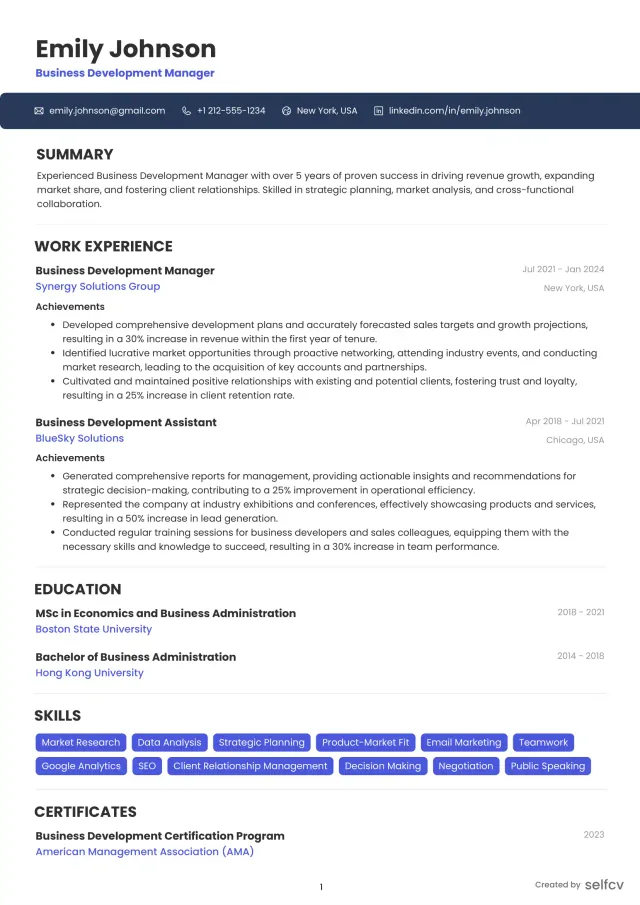
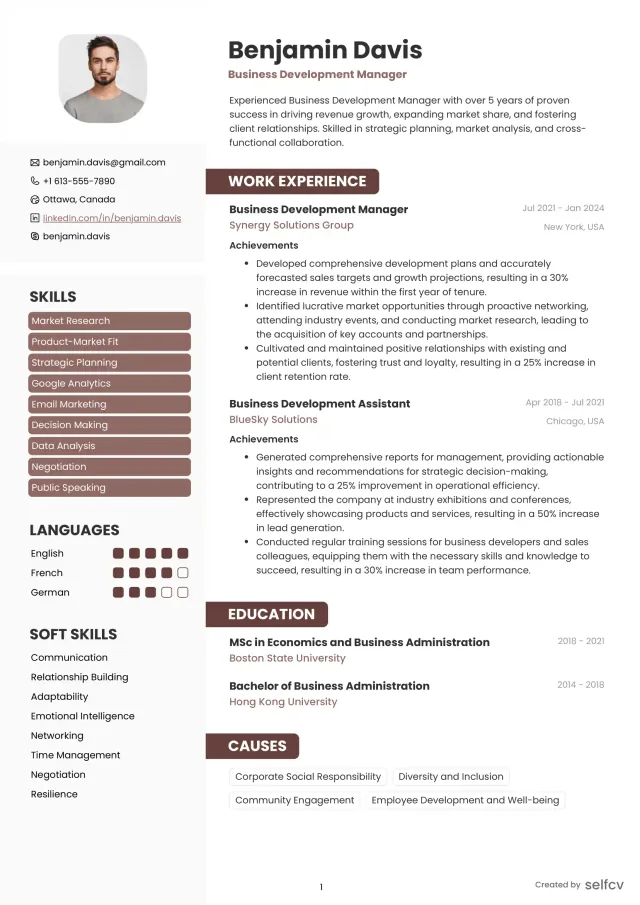
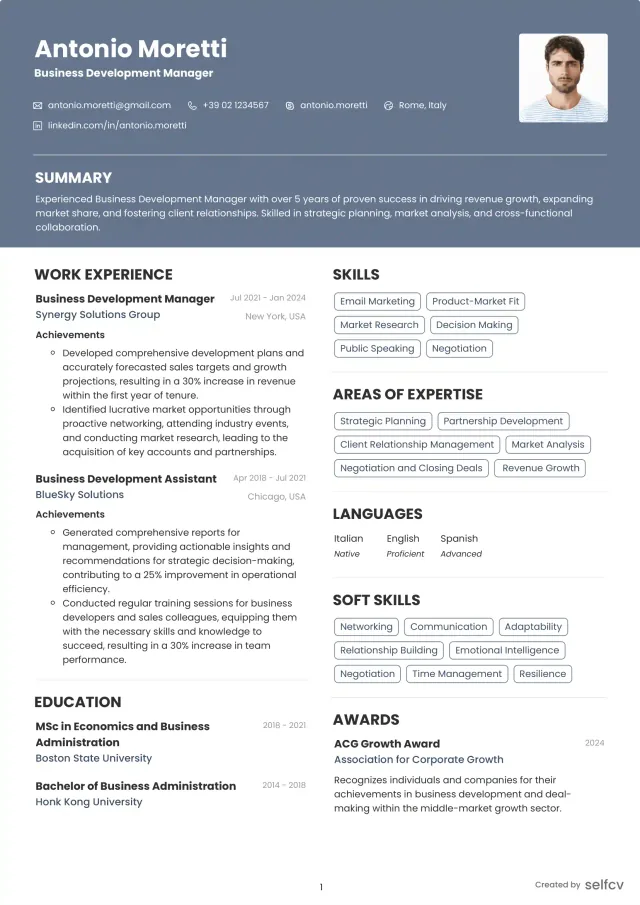
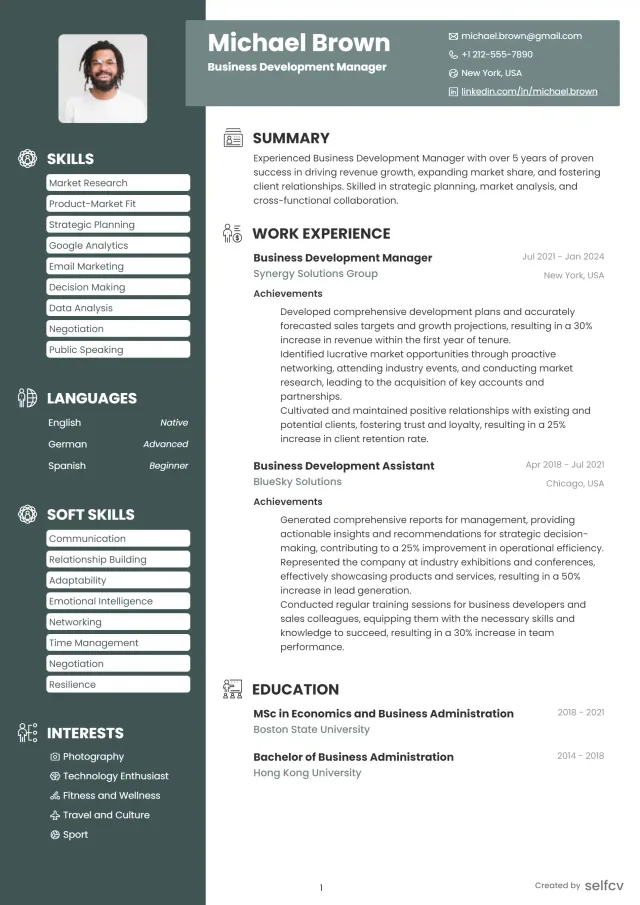
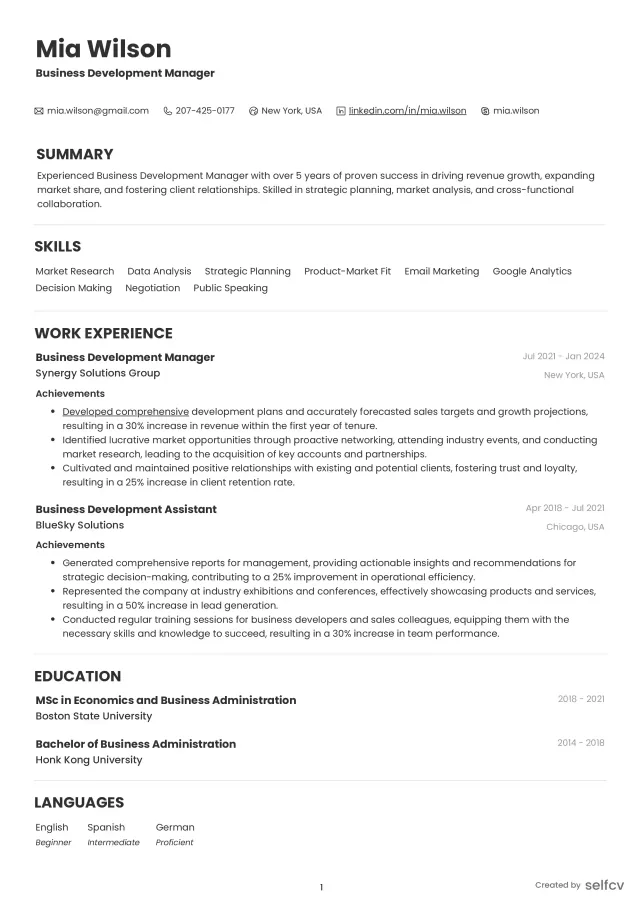
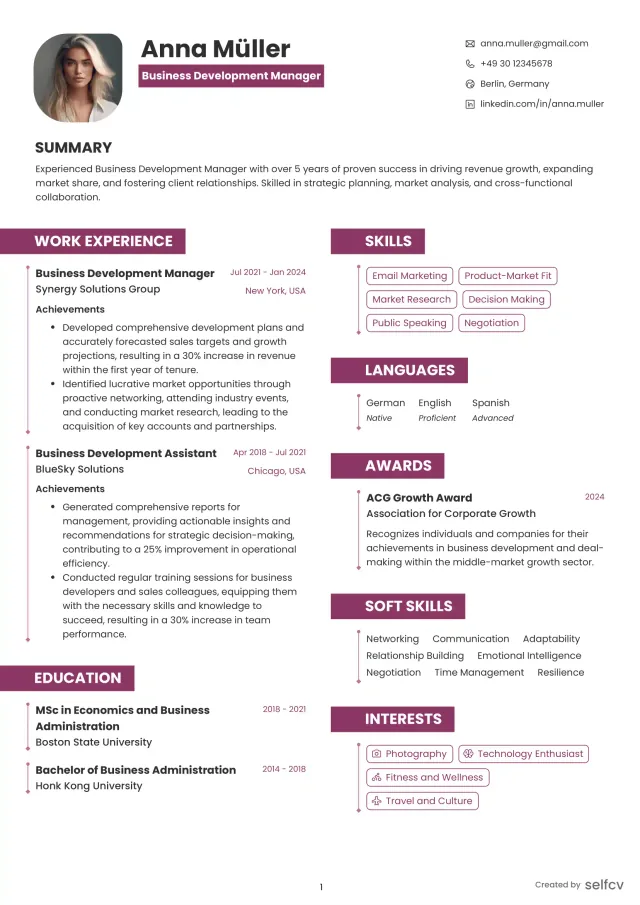
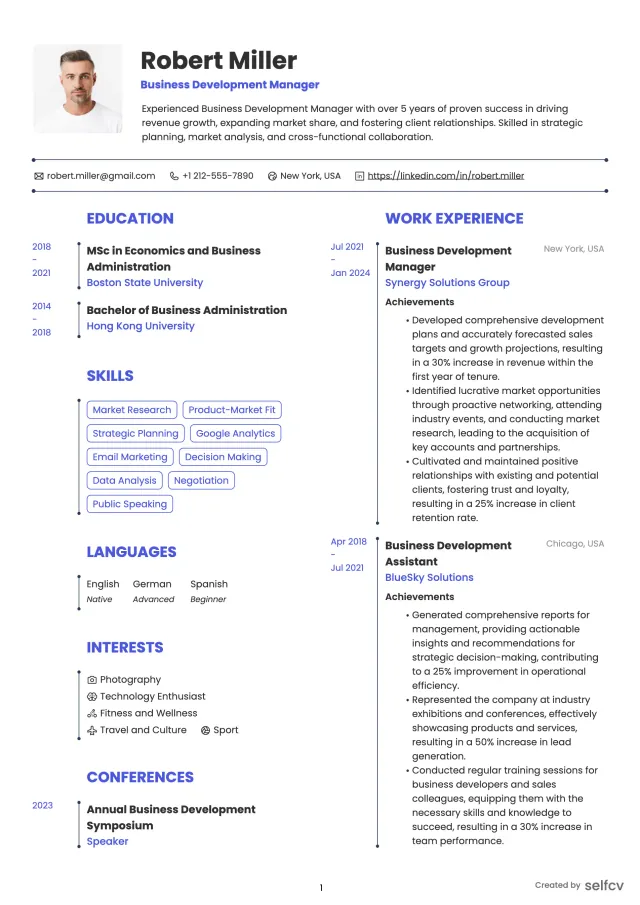
Find the template that’s right for you
No need to build anything from scratch. Using our templates or upload feature, you’ll get started easily and have a powerful resume in a few clicks.
How to show measurable impact - metrics and achievement examples
Metrics that matter
- Organic sessions and keyword rankings
- Conversion rate lift tied to content funnels
- Time on page, scroll depth, and engaged sessions
- Production efficiency (time-to-publish, reduced review cycles)
- Revenue-attributable metrics (MQLs, ARR influenced)
Achievement examples (weak-to-strong)
Example 1:
Weak:
- Performed content audit and updated pages.
Strong:
- Led a 600-page content audit, prioritized 120 pages for rewrite, and drove a 24% organic traffic lift to priority pages in 4 months.
Why it works:
- Adds scope, prioritization, timeframe, and measurable outcome.
Example 2:
Weak:
- Improved site taxonomy.
Strong:
- Redesigned product taxonomy across 5 categories, reduced internal search drop-off by 18% and improved findability for high-intent queries within 3 months.
Why it works:
- Connects taxonomy work to user behavior metrics and a clear timeframe.
Example 3:
Weak:
- Worked with product and design on in-app content.
Strong:
- Partnered with product and UX to pilot contextual onboarding content, increasing new-user activation by 12% and reducing support tickets by 9% in the pilot cohort.
Why it works:
- Shows cross-functional influence, experimental approach, and multiple measurable outcomes.
Portfolio and case-study structure for your resume
What to include in each case study
- One-line problem statement and business goal
- Your role and what you owned
- Approach: research, framework, and prioritization method
- Execution: deliverables, tools, and collaborators
- Outcome: metrics with baseline, timeframe, and scale
Three short portfolio snippets (one-paragraph each)
Snippet 1 - SEO-led product content
- Problem: Low organic traffic for product docs causing support volume to spike.
- Approach: Performed keyword gap analysis and content audit, prioritized 40 pages for consolidation and canonicalization.
- Outcome: 38% organic session increase to docs pages and 22% reduction in support tickets in 6 months.
Snippet 2 - Taxonomy redesign
- Problem: Poor findability in internal search and inconsistent metadata.
- Approach: Ran content inventory, built a 3-tier taxonomy with stakeholder workshops, implemented metadata templates in CMS.
- Outcome: Search conversion improved by 14% and editorial time-to-publish decreased by 25%.
Snippet 3 - Governance playbook
- Problem: Content quality inconsistent across regions.
- Approach: Designed a governance playbook with approval flows and QA checklists, rolled out training to global teams.
- Outcome: First-pass content approvals rose from 62% to 88% and localization throughput improved.
Check Your Resume with ATS
Make sure your resume passes Applicant Tracking Systems before recruiters see it.
- 📄 Upload your resume and get instant ATS feedback
- 🎯 Improve keyword matching for your target job
- ⚡ Boost your chances of getting shortlisted
Complete fictional resume example
The candidate, companies, and career history shown are fictional examples created for illustration and any resemblance to a real person or organization is coincidental.
Candidate Name
Alex Mercer
Target Position
Senior Content Strategist
Location
Seattle, WA (open to remote)
Professional Summary
Content strategist with 7 years building SEO-led product content and content operations for B2B SaaS. Led taxonomy redesigns, governance, and cross-functional pilots that increased organic traffic and reduced support load. Comfortable with Headless CMS, GA4, and stakeholder alignment from IC to exec level.
Grouped Skills
- Strategy: content strategy, content lifecycle, governance
- SEO & measurement: keyword research, GA4, Ahrefs, conversion tracking
- Ops & CMS: Contentful, editorial workflows, content migrations
- Design & research: information architecture, Figma, user interviews
Professional Experience:
Senior Content Strategist, NovaTech (fictional)
- Led a 2-person content strategy team and owned the product content roadmap for a 12M monthly-visit platform.
- Ran a 900-page audit, prioritized 140 pages for consolidation, producing a 29% increase in organic sessions to targeted pages within 5 months.
- Designed and implemented a taxonomy and metadata model that reduced internal search drop-off by 16% and sped up content retrieval for engineering by 20%.
- Built an editorial governance playbook with approvals and localization checkpoints, increasing first-pass approvals to 90%.
Content Strategist, Brightline Apps (fictional)
- Owned content strategy for onboarding funnels and help center, working with product and support to reduce friction.
- Piloted contextual in-app help that lifted new-user activation by 10% and lowered weekly support tickets by 11% during the pilot.
- Implemented content performance dashboards in Looker and GA4 to track engagement and conversion by cohort.
Associate Content Strategist, MediaLeaf (fictional)
- Conducted keyword research and coordinated content production for a 150-page product documentation site.
- Managed CMS migrations and metadata tagging during a platform change, decreasing broken links by 98% post-migration.
Education / Training
- BA, Communication Studies, University of Washington
Certifications
- Google Analytics 4 Certified
- HubSpot Content Marketing Certification
Resume summaries and objectives by career level
Entry / Associate Content Strategist summary
- Objective example:
- "Entry-level content strategist with experience in SEO research and content audits. Built editorial calendars for a startup and supported site migrations; seeks to grow in content operations and taxonomy design."
Mid-level Content Strategist summary
- Summary example:
- "Content strategist with 3-6 years experience delivering SEO and product content programs. Led 200+ page audits and partnered with product teams to increase content-driven conversions by double digits."
Senior / Lead Content Strategist summary
- Summary example:
- "Senior content strategist with 7+ years leading content operations and governance for SaaS. Defined taxonomy and measurement frameworks that scaled global production and increased organic revenue attribution."
Career changer objective (from content marketing or UX writing)
- Objective example:
- "Content marketer transitioning to content strategy; experienced in editorial planning and SEO. Can translate audience research into prioritization frameworks and governance to scale cross-functional content programs."
Interview talking points and 30/60/90-day plan
High-impact talking points for interviews
- Describe a content decision you led that changed user behavior and the metrics used to measure it.
- Explain a time you aligned conflicting stakeholders and how you prioritized content work.
- Walk through a content audit example and the prioritization logic you applied.
30/60/90-day plan (concise)
- 30 days: Audit top-performing content, meet stakeholders, map current workflows and tooling.
- 60 days: Propose prioritization framework, quick wins for high-impact pages, and a measurement dashboard.
- 90 days: Launch a pilot (taxonomy, governance, or in-app content), set KPIs, and establish production cadence.
Use these talking points to steer conversations toward measurable outcomes and cross-functional influence.
Common resume mistakes and quick fixes
Top mistakes
- Listing only tasks without outcomes
- Using vague metrics with no baseline or timeframe
- No portfolio link or unlabeled case studies
- Overloading the resume with tactical tools but no strategic context
Quick fixes
- Convert tasks into achievements using this format: action, scope, metric, timeframe
- Replace vague verbs with ownership verbs (led, defined, governed)
- Include 1-3 portfolio case studies with outcomes
- Tailor keywords to the job while keeping honest descriptions of scale and tools
Related careers
Roles that connect well with content strategy
- Content Manager
- UX Writer
- SEO Specialist
- Product Manager
- Content Operations Manager
- Content Designer
How to position for transitions
- From SEO Specialist: emphasize content frameworks and governance experience
- From UX Writing: highlight information architecture and cross-functional influence
- From Product Management: show how content decisions moved product KPIs
Conclusion: 5-point action checklist and next steps
Practical conclusion
A strong Content Strategist resume in 2026 shows strategic thinking, governance, measurable outcomes, and concise portfolio evidence. Focus on work that proves you can scale content and influence product and marketing decisions.
5-point action checklist
- Write a 1-line strategy summary that states scope and outcome.
- Add 2-4 measurable achievements with baseline and timeframe.
- List relevant tools and CMS with scale (team size, traffic).
- Prepare 1-3 one-page portfolio case studies with problem, approach, execution, outcome.
- Tailor ATS keywords from the job description into your experience lines naturally.
Next action
- Update one role on your resume using the achievement format above and prepare a one-page portfolio case study for that project.
30/60/90-day interview talking points (quick reminder)
- 30: map content landscape and stakeholders.
- 60: propose prioritized roadmap and measurement approach.
- 90: launch a pilot and report results.
Templates and next steps
- Convert one strong project into a one-page case study and add it to your resume header as a labeled portfolio link.
- Practice two interview stories that connect strategy to a measurable outcome and a cross-functional influence example.
Why job seekers choose selfcv
Thousands of professionals use selfcv to build modern, ATS-friendly resumes, customize templates, and apply for jobs with confidence.
Thanks to SelfCV, I now have a professional and polished resume that I'm confident in sending to potential employers. I will definitely be recommending your service to other job seekers. Keep up the great work!
SelfCV offers an intuitive interface that makes creating a professional CV straightforward. Whether you're a student, a fresh graduate, or an experienced professional, the step-by-step process ensures that users of all levels can craft an impressive CV.
Easy to use resume builder. They have very intuitive ui for customizing and keeping multiple versions of resume.
The right tool for creating CVs. As a student I was looking for a tool that could help me quickly create a CV for internship applications. This was just the right tool. I am very satisfied!
This is one of the best tools I’ve ever used - I was able to build my CV in seconds with high quality template. Highly recommended!
Amazing app with easy user experience. Loved it. Its intuitive and easy to navigate, designs are very nice.
