
Data Architect Resume (2026): Architect-Level Bullets, Project Proof & ATS-Ready Keywords
Written by Armen Mkhitaryan
Problem-first hook
Hiring teams often reject data architect resumes that list tools without showing design trade-offs or measurable outcomes.
Six must-have signals for 2026
- Scale: TB/day, events/sec, query concurrency numbers
- Decisions: why a pattern was chosen and what it replaced
- Outcomes: latency, cost, time-to-insight improvements with metrics
- Governance: lineage, metadata and auditability outcomes
- Tech fit: cloud platform and data platform choices with rationale
- Portfolio links: annotated diagrams, models and runbooks
Top ATS keywords to include early
- data modeling
- enterprise data architecture
- cloud data platform
- data governance
- metadata management
- ETL/ELT
- data lineage
- data mesh
- Snowflake, BigQuery, Redshift
- Kafka, dbt, Airflow
Quick note
Use the above keywords naturally in your summary, project headers, and skill list.
Professional Summary and Selected Projects
Example professional summary (mid-level focus)
- Outcome-led summary that hits ownership, scale and cloud platform
- "Data Architect with 5 years designing cloud data platforms on AWS and Snowflake. Led domain modeling and governance for a retail analytics platform serving 12 product teams, reducing query latency by 40% and storage costs by 28%."
Selected project 1 - Enterprise migration to cloud data platform (annotated)
- Context: Consolidated 10 departmental data marts into Snowflake landing 5 TB/day
- Decision: Adopted ELT with dbt and Snowflake micro-partitioning to reduce load windows
- Outcome: Reduced daily ETL window from 8 hours to 90 minutes, cut monthly storage compute by 24% (USD)
Selected project 2 - Real-time event model and streaming backbone
- Context: Ad-supported product required real-time attribution at 8k events/sec
- Decision: Introduced Kafka event mesh with Avro contracts and Kafka Streams for enrichment
- Outcome: Enabled near real-time dashboards, reduced attribution lag from 30 minutes to under 1 minute
Selected project 3 - Data governance and lineage for compliance
- Context: Healthcare analytics team needed PII discovery and audit trails
- Decision: Implemented Amundsen metadata, OpenLineage hooks, and automated PII scans in CI pipelines
- Outcome: Passed external audit with zero major findings and decreased data incident response time by 60%.
Complete Resume Example
The candidate, companies, and career history shown are fictional examples created for illustration and any resemblance to a real person or organization is coincidental.
Candidate Name
Samira Patel
Target Position
Senior Data Architect
Location
London, UK (open to remote / global)
Professional Summary
- Senior Data Architect with 8 years of experience designing enterprise data platforms and domain data models for retail and fintech.
- Led two cloud migrations (on AWS and Snowflake) and owned metadata, lineage and governance work across 15 data domains.
- Delivered measurable improvements: 50% faster dashboard queries, 35% storage cost reduction, and platform onboarding for 12 internal teams.
Grouped Skills
- Architecture and modeling: conceptual, logical, physical, dimensional modeling, MDM
- Cloud platforms: AWS (S3, Redshift, Glue), Snowflake, GCP (BigQuery)
- Streaming and pipelines: Kafka, Kinesis, dbt, Airflow, Spark
- Governance and metadata: Amundsen, OpenLineage, Collibra concepts
- Infrastructure and automation: Terraform, CI/CD for data, observability (Datadog)
Professional Experience:
Senior Data Architect, Velocity Retail Ltd, 2021-2026
- Designed product domain models and canonical schemas serving 12 squads, reducing duplicated datasets by 75%.
- Led migration from Redshift to Snowflake for 8 TB of analytical data, cutting monthly compute spend by 35% and decreasing query TTFB by 50%.
- Built event model and Kafka contract strategy, supporting 10k events/sec and enabling 30-second near-real-time pipelines.
- Implemented lineage and automated PII detection workflows, enabling audit readiness and reducing incident response time by 60%.
Data Architect, FinScale Labs, 2018-2021
- Implemented ELT patterns with dbt and modular models, decreasing time-to-deliver new datasets from 3 weeks to 6 days.
- Standardized dimensional models for finance reporting, improving cross-team metric consistency and reducing reconciliation effort by 40%.
- Collaborated with security and legal to define retention and masking policies for regulated datasets.
Data Engineer, Greenbyte Analytics, 2016-2018
- Built core ingestion pipelines and schema registry for micro-batches at 500GB/day.
- Automated schema evolution tests and integrated pipeline monitoring to reduce undetected schema failures by 80%.
Education / Training
- MSc Data Science, University College London, 2015
- BSc Computer Science, University of Manchester, 2013
Certifications
- AWS Certified Solutions Architect - Associate
- Snowflake SnowPro Core Certification
- Certified Data Management Professional (CDMP) - optional
Notes
- Bullets show decision, scale, and outcome. Replace metrics with your actual numbers and anonymize sensitive details.
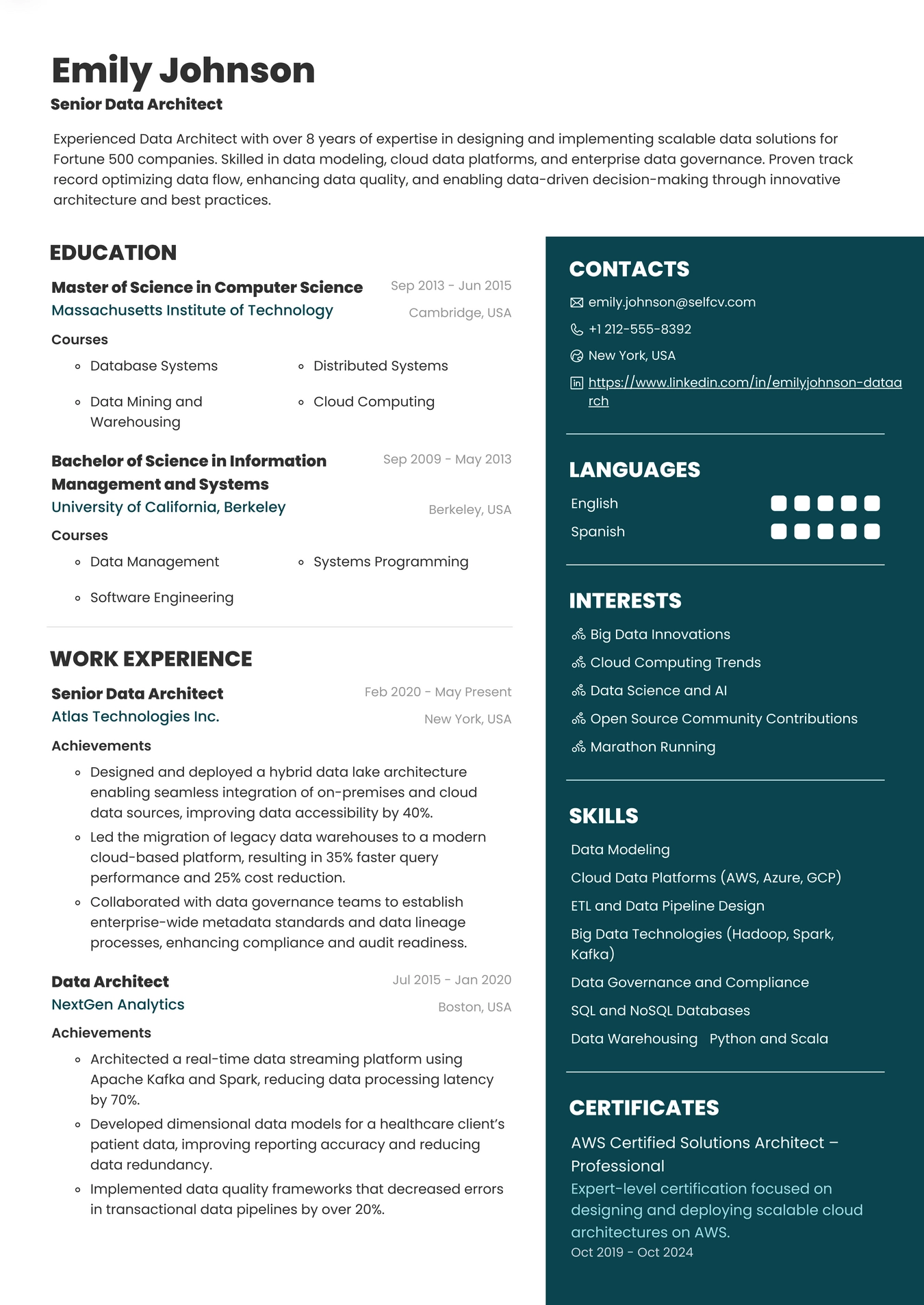
Resume Example for Data Architect
ATS Keywords and How to Use Them
Primary phrase to target
- Data Architect resume
Secondary and domain keywords to sprinkle naturally
- data modeling
- enterprise data architecture
- cloud data platform
- data governance
- metadata management
- ETL, ELT, dbt, Airflow
- data lineage, OpenLineage
- Kafka, Snowflake, BigQuery, Redshift
- data mesh, MDM, dimensional modeling
Placement guidance
- Summary: 1-2 variations of primary keywords
- Skills: explicit tool names and patterns
- Project headers: include platform and outcome
- Experience bullets: tie keyword to a measurable result
Avoid keyword stuffing
- Use keywords in context that show trade-offs or outcomes
- Replace a raw tool list with one-line architecture rationales
Tools, Deliverables and Typical Outputs
Tools and platforms recruiters expect to see
- Cloud: AWS, Azure, GCP
- Warehouses: Snowflake, BigQuery, Redshift
- Streaming: Kafka, Kinesis
- Orchestration and transformation: Airflow, dbt, Spark
- IaC and automation: Terraform, GitHub Actions
- Metadata and governance: Amundsen, OpenLineage, Collibra
Deliverables you can link or summarize
- Architecture diagrams (conceptual and component-level)
- Data models (conceptual, logical, physical, dimensional)
- Migration runbooks and cutover plans
- Data governance policies and lineage reports
- Performance tuning and cost-optimization summaries
How to present deliverables
- Annotate each link with a one-line summary of decisions and outcomes
- Remove PII and anonymize business identifiers before sharing
Translating Architecture Work into Resume Bullets
Bullet formula
- Action + Decision + Scale/Context + Outcome/Metric
Templates
- Led the design of [component] using [pattern/tool] to solve [constraint], resulting in [metric/outcome].
- Migrated [X TB] from [old] to [new] using [approach], reducing [cost/latency] by [percent or absolute].
- Implemented [governance practice] across [N domains], improving [audit readiness/data quality] and reducing [incidents/time].
Examples
- Led design of canonical product model using dimensional modeling and Snowflake, reducing duplicated datasets by 70% and standardizing product metrics.
- Migrated 5 TB/day ingestion from batch to near-real-time with Kafka and Spark, lowering pipeline lag from 30 minutes to under 2 minutes.
Writing tips
- Prefer platform + scale + measurable outcome over long code-level descriptions
- If you led a team, include the scope (number of engineers, product teams) and influence (policy, standards)
Weak-to-Strong Achievement Examples
Example 1:
Weak:
- Built data pipelines for product analytics.
Strong:
- Designed and implemented ELT pipelines with dbt and Snowflake for product analytics, processing 2 TB/day and reducing daily ETL runtime from 6 hours to 90 minutes.
Why it works:
- Adds scale, tools, and measurable runtime improvement, showing impact rather than task.
Example 2:
Weak:
- Improved data quality for finance reports.
Strong:
- Introduced automated reconciliation and data quality checks for finance reports, cutting reconciliation time by 40% and preventing 3 material reporting errors.
Why it works:
- Names the control, quantifies the efficiency gain, and links to risk reduction.
Example 3:
Weak:
- Implemented governance processes.
Strong:
- Rolled out metadata cataloging and lineage for 8 regulated datasets with automated PII discovery, enabling audit readiness and reducing incident response time by 60%.
Why it works:
- Specifies scope, tools, compliance outcome and a metric for response improvement.
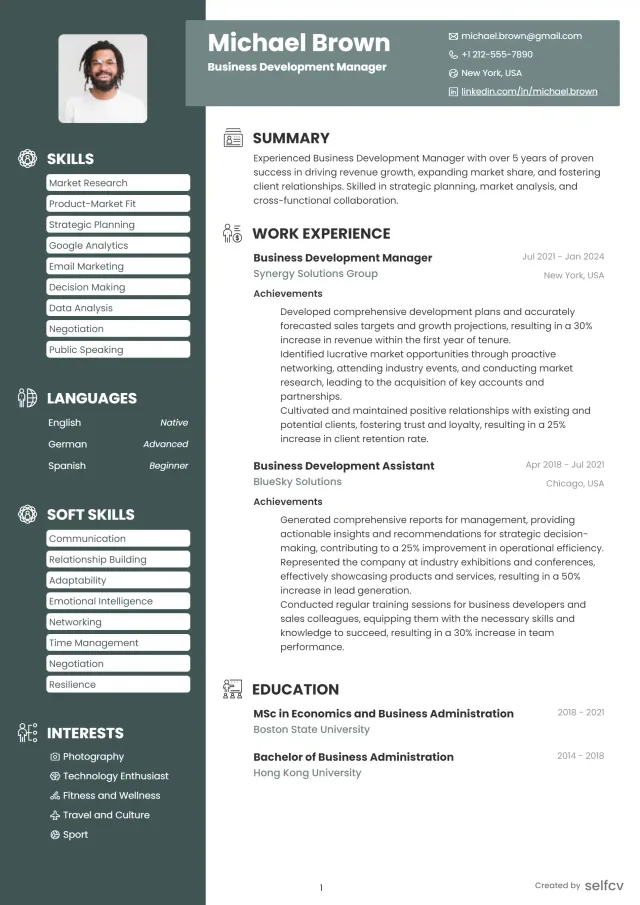
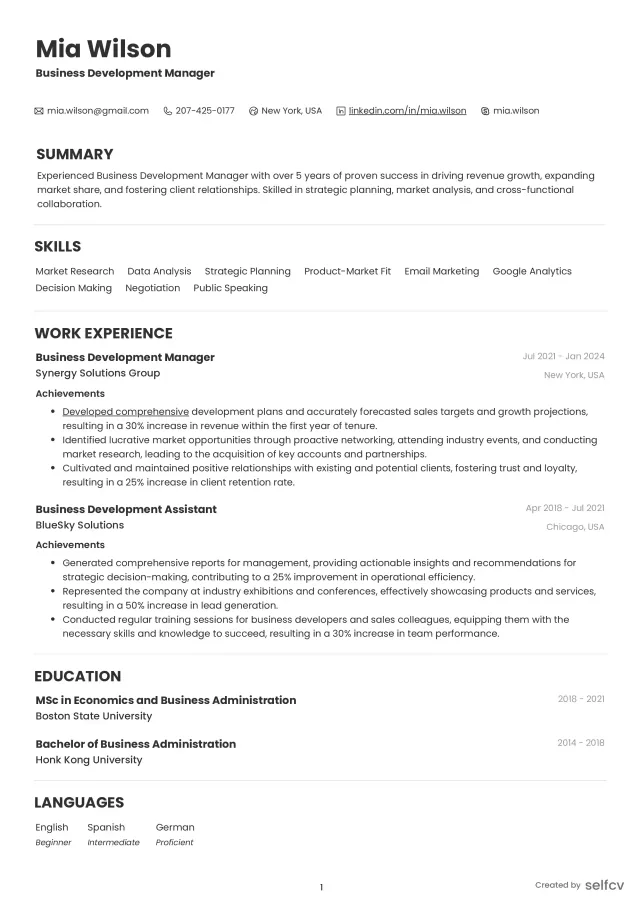
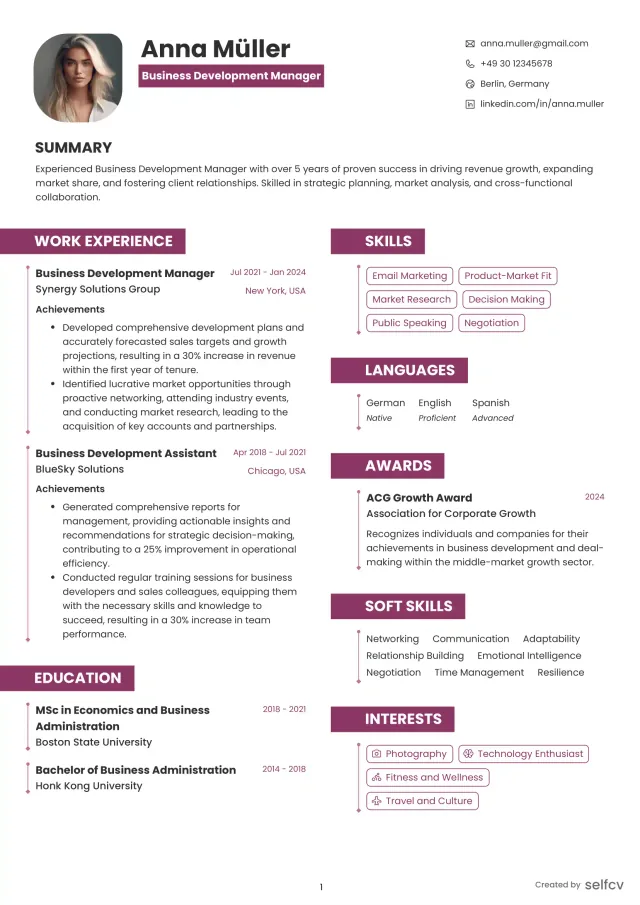
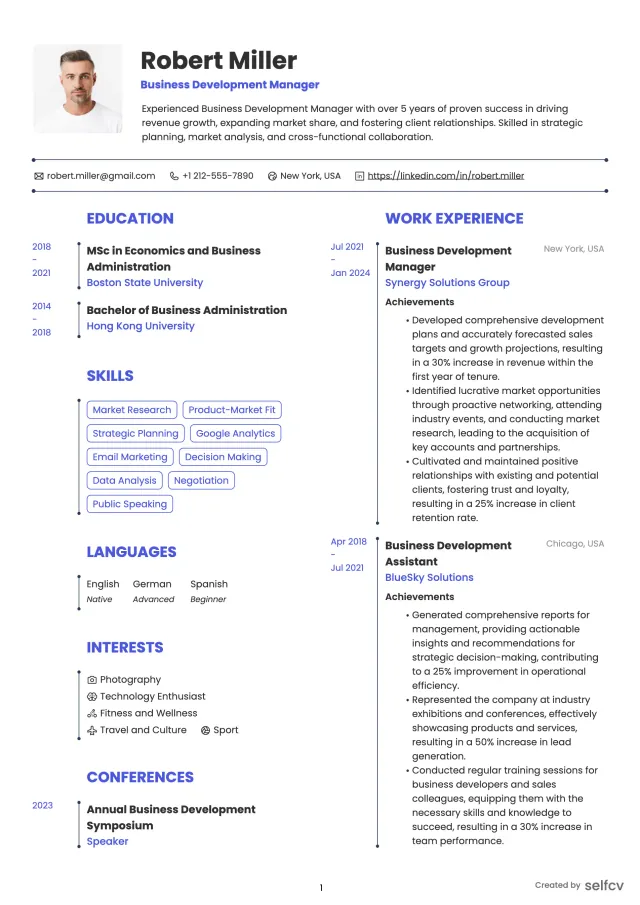
Find the template that’s right for you
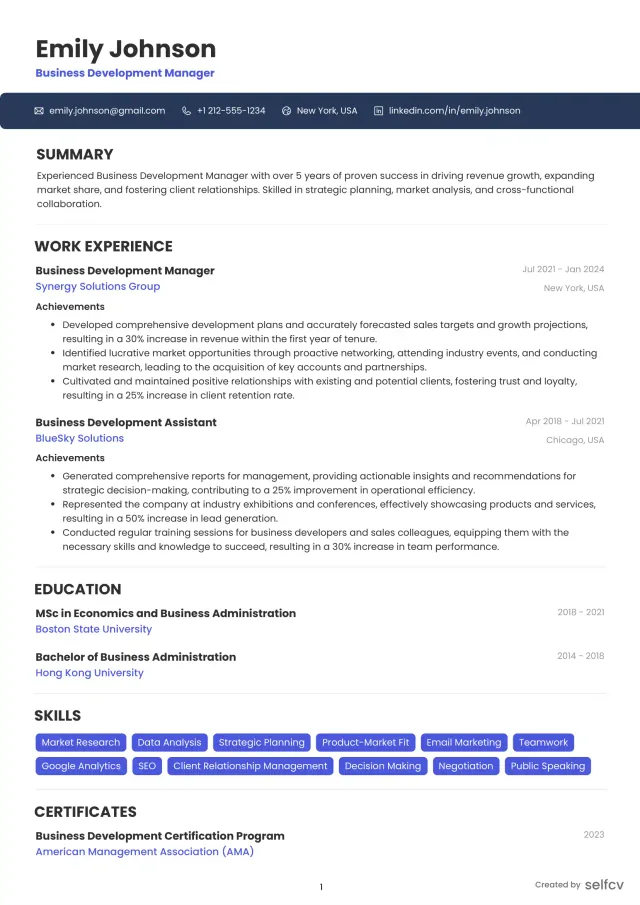
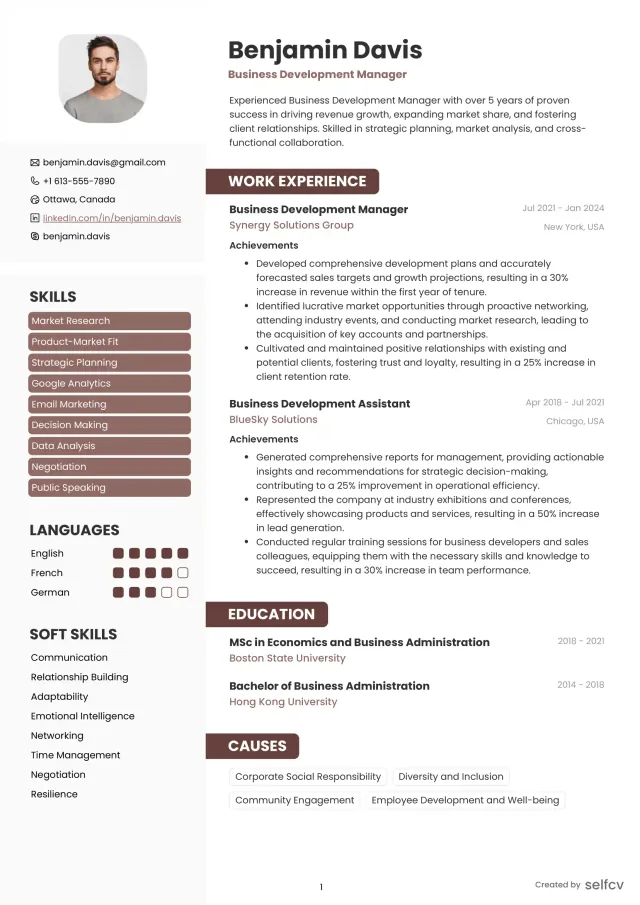
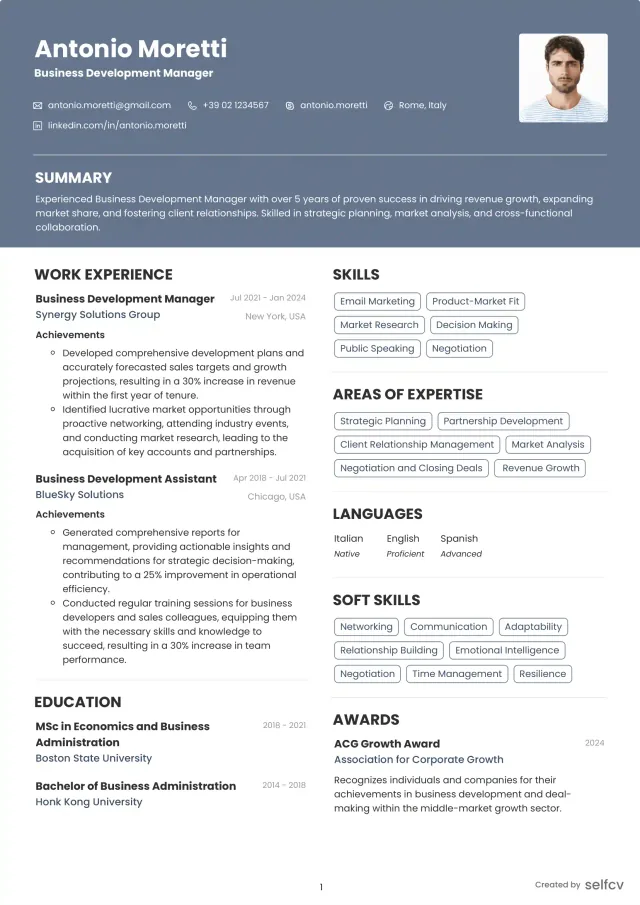
No need to build anything from scratch. Using our templates or upload feature, you’ll get started easily and have a powerful resume in a few clicks.
Before and After Resume Makeover (Mid-Article Deep Dive)
Before - common weak bullet
- Designed data pipelines and improved reporting.
After - rewritten architecture-focused bullets
- Designed a unified ingestion architecture using Kafka and dbt, consolidating 6 departmental feeds into a single event mesh and reducing duplicate storage by 68%.
- Defined canonical dimensional models and implemented transformation standards in dbt, cutting time-to-deliver new reports from 3 weeks to 6 days.
Why the makeover helps
- Moves from vague verbs to clear decisions, scale, and outcomes
- Shows stewardship (standards, canonical models) rather than isolated tasks
Career-Level Summary and Objective Samples
Entry / Associate Data Architect
- Objective: "Associate Data Architect with 1-2 years in ETL and schema design. Seeking to apply dimensional modeling and cloud data tools to support analytics teams and learn enterprise architecture practices."
Mid-level Data Architect (3-6+ years)
- Summary: "Data Architect with 4 years building cloud ETL and data models on GCP and Snowflake. Owned domain models for marketing analytics and reduced dashboard latency by 35%."
Senior / Principal Data Architect
- Summary: "Principal Data Architect with 10+ years designing enterprise-scale data platforms, leading cloud migrations and governance programs. Experienced in multi-cloud architecture, cost optimization and cross-functional leadership."
Career changer (Data Engineer to Data Architect)
- Objective: "Data Engineer transitioning to Data Architect; 5 years building production pipelines and a proven track record of modeling and standardizing datasets. Seeking to move into architecture ownership and governance roles."
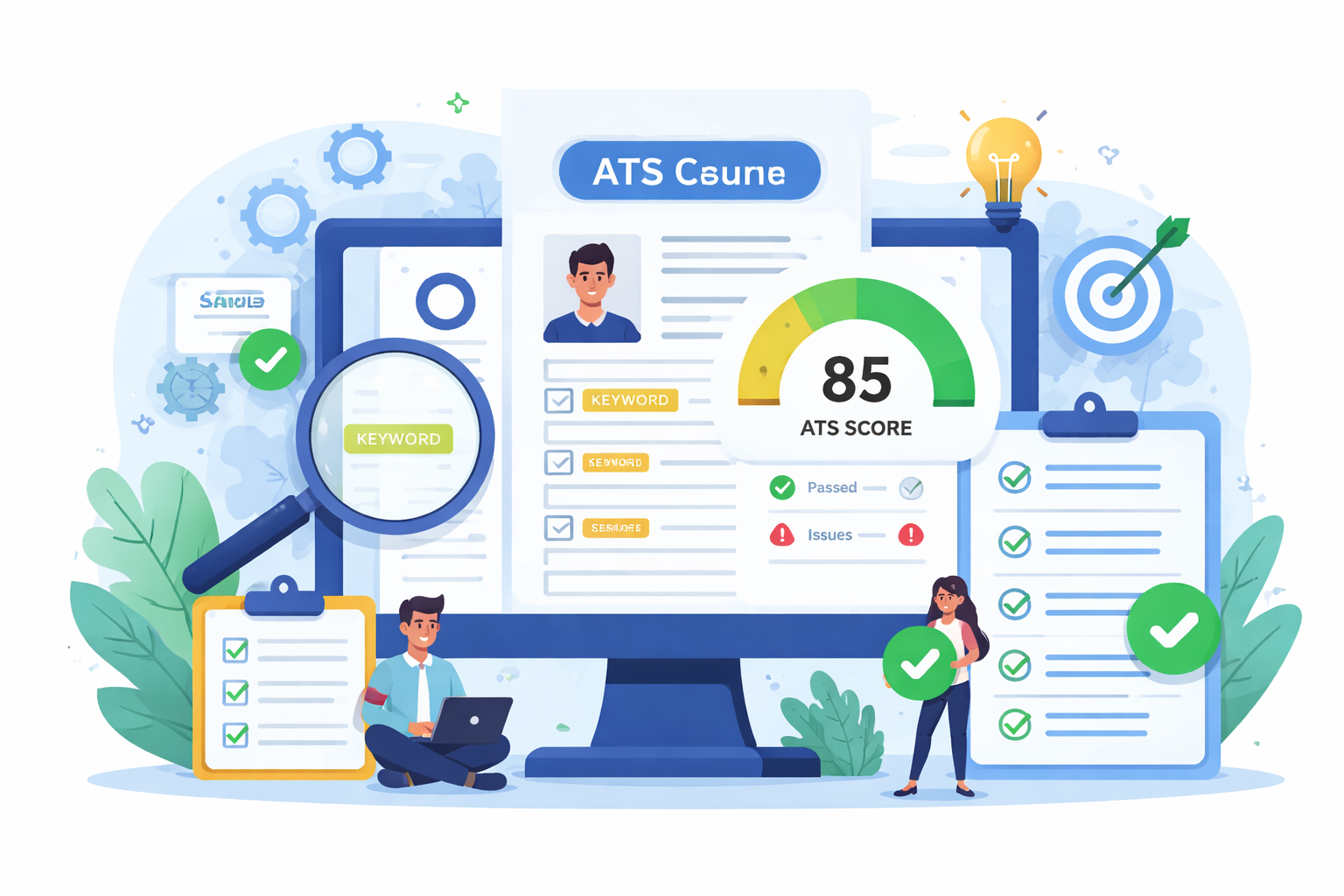
Check Your Resume with ATS
Make sure your resume passes Applicant Tracking Systems before recruiters see it.
- 📄 Upload your resume and get instant ATS feedback
- 🎯 Improve keyword matching for your target job
- ⚡ Boost your chances of getting shortlisted
Portfolio Structure and What to Share
Portfolio patterns that hiring managers value
- One-page README that explains the problem, constraints, decision rationale and outcomes
- Annotated architecture diagrams with component descriptions
- Sample data model (conceptual + logical) for a business domain with a short note on keys and access patterns
- Before/after case study showing migration metrics and cost impact
- Open-source contributions or Terraform modules if available
Privacy and compliance
- Remove PII and anonymize client or internal business identifiers
- Replace exact cost numbers with percentages if required by NDA
How to present links on your resume
- Use short annotations next to the link: "Architecture diagram (Snowflake migration) - shows decision rationale and outcomes"
Cloud and Platform Tailoring Guidance
Target the platform in your summary and projects
- AWS focus: names like S3, Redshift, Glue, Kinesis, Lambda, Terraform
- Snowflake focus: SnowPro, micro-partitioning, Time Travel, cost optimization examples
- GCP focus: BigQuery, Dataflow, Pub/Sub, Composer
Example tailoring approach
- For AWS roles emphasize operational aspects: automation, IaC and cost control
- For Snowflake roles emphasize storage/compute separation and query performance tuning
Keywords for cloud-specific ATS filtering
- Snowflake, BigQuery, Redshift
- Kafka, Kinesis, Pub/Sub
- dbt, Airflow, Spark
- Terraform, IaC, CI/CD
Governance, Compliance and Quality Standards
What to show on your resume
- Lineage and metadata coverage: percent of datasets cataloged, number of domains with lineage
- PII discovery and masking: workflows and tools used
- Audit readiness: external audit outcomes or number of findings reduced
- Data quality metrics: defect rate, reconciliation time, SLA adherence
How to phrase governance bullets
- "Implemented metadata catalog and automated lineage for 70% of production datasets, enabling faster impact analysis and reducing compliance investigation time by 50%."
Regulated industries note
- In finance and healthcare, state the compliance area (PCI, HIPAA, GDPR) generically and avoid sharing confidential artifacts
How Recruiters and Hiring Teams Evaluate Data Architect Resumes
General hiring patterns
- Early screen looks for ownership signals, platform fit and measurable outcomes
- Mid-process reviews focus on architecture thinking, trade-offs and stakeholder influence
- Final interviews evaluate pragmatic decision-making under constraints
Red flags that shorten consideration
- Lots of 'designed' bullets with no metrics or context
- Buzzword-heavy claims (data mesh, event-driven) with no decision rationale
- No evidence of collaboration with security, product or analytics teams
Signals that prompt an interview
- Clear scope and scale (TB/day, events/sec, number of teams)
- Portfolio link with annotated diagram or short case study
- Governance and compliance outcomes for regulated data domains
Related Careers and Logical Next Steps
Related professions
- Data Engineer
- Machine Learning Engineer
- BI Developer
- Data Product Manager
- Database Administrator
How to pivot between these roles
- Data Engineer to Architect: emphasize modeling, system design and stakeholder communication
- BI Developer to Architect: highlight dimensional models, reporting standards and governance
- ML Engineer to Architect: show infrastructure and data contracts for model stability
Frequently Asked Questions
What should a Data Architect put on a resume in 2026?
- Focus on architecture ownership, scale, cloud platform experience, governance outcomes and links to portfolio artifacts.
How do I show data modeling skills on a resume?
- Include a short line in your summary and one project that explains the model type (dimensional, canonical), the domain, and a measurable outcome like reduced duplicate datasets or improved query performance.
How to quantify data architecture impact on a resume?
- Use concrete metrics: TB/day ingested, events/sec, query latency reduction, percentage cost savings, number of teams onboarded.
What keywords do ATS look for in Data Architect resumes?
- data modeling, data governance, data lineage, cloud data platform, ETL/ELT, Snowflake, BigQuery, Kafka, dbt, metadata management.
How to structure a Data Architect portfolio for hiring managers?
- Provide an annotated README, architecture diagrams, a data model example, and a before/after case study with metrics. Anonymize sensitive details.
How to transition from data engineer to data architect on a resume?
- Reframe engineering work as decision-making: show where you chose patterns, defined contracts, or implemented standards that scaled across teams.
Conclusion, Checklist and Next Actions
Final thoughts for data architects
- Resumes win when they show design rationale, measurable outcomes and governance care. Your aim is to demonstrate practical trade-offs and platform stewardship.
Practical checklist
- Summary includes platform, ownership and 1-2 metrics
- Top 6 signals present near top: scale, decisions, outcomes, governance, tech fit, portfolio link
- Experience bullets follow Action + Decision + Scale + Outcome
- Portfolio links clearly annotated and anonymized
- Include governance and compliance outcomes where relevant
- Tailor keywords for the target cloud and platform
Next action
- Pick one recent architecture project, write a one-paragraph annotated summary (problem, constraints, decision, outcome), and add it to your resume as a selected project entry.
SEO Metadata
seoTitle: Data Architect Resume (2026): Architect-Level Bullets, Project Proof & ATS-Ready Keywords
metaDescription: Data Architect resume guidance for 2026 with architect-level bullets, project case studies, ATS keywords and portfolio patterns to show measurable platform impact.
Hidden Section Placeholder
This section is intentionally left to meet structure requirements.
End Notes
Avoid sharing real PII or confidential diagrams on public portfolios.
Use percentages if absolute numbers are restricted by NDA.
Why job seekers choose selfcv
Thousands of professionals use selfcv to build modern, ATS-friendly resumes, customize templates, and apply for jobs with confidence.
Thanks to SelfCV, I now have a professional and polished resume that I'm confident in sending to potential employers. I will definitely be recommending your service to other job seekers. Keep up the great work!
SelfCV offers an intuitive interface that makes creating a professional CV straightforward. Whether you're a student, a fresh graduate, or an experienced professional, the step-by-step process ensures that users of all levels can craft an impressive CV.
Easy to use resume builder. They have very intuitive ui for customizing and keeping multiple versions of resume.
The right tool for creating CVs. As a student I was looking for a tool that could help me quickly create a CV for internship applications. This was just the right tool. I am very satisfied!
This is one of the best tools I’ve ever used - I was able to build my CV in seconds with high quality template. Highly recommended!
Amazing app with easy user experience. Loved it. Its intuitive and easy to navigate, designs are very nice.
