
Product Designer Resume Blueprint 2026: Turn Case Studies into Measurable Impact and ATS-Ready Keywords
Product Designer Resume Blueprint 2026: Turn Case Studies into Measurable Impact and ATS-Ready Keywords
Written by Armen Mkhitaryan

Three hiring blockers for product designers (and what this article fixes)
Vague impact statements that read like task lists
- Fixes: convert tasks into outcomes with metrics and product context
Missing product context or ownership level
- Fixes: explain scope, timeframe, team size, and decision rights for each project
Poor portfolio linkage and unclear evidence
- Fixes: show one-click case study links, short resume callouts, and deliverable thumbnails
How hiring works for product design roles in 2026
High-level patterns hiring teams use when screening designers
- Hiring managers often look for evidence of production ownership and measurable improvements.
- Recruiters screen for signals that scale in an ATS: keywords, role titles, and measurable outcomes.
- Interviewers expect a narrative: problem, constraints, decisions, and measurable results.
What this means for your resume
- Lead with product outcomes and the role you played.
- Use clear job titles that match the role you want (senior product designer, mobile product designer).
- Make portfolio evidence one click away and cite specific releases, A/B tests, or metrics on the resume.
Resume Example for Product Designer
ATS essentials for product designer resumes
Top ATS and keyword rules
- Use your primary keyword near the top: product designer resume or product designer.
- Include role variations as secondary keywords: ux designer, mobile product designer, design systems, senior product designer.
- Avoid images or fancy columns; use a single readable column.
Formatting and export
- File type: PDF for human review, optionally plain text when an application requests it.
- Fonts: system fonts (Helvetica, Arial, Inter) for reliability.
- Headline: one-line role/title followed by a 1-2 line summary.
Where to put the portfolio link
- Top of the resume under contact info and again in project bullets.
- Use clear labels: Portfolio: yourdomain.com or Case study: Short title (link).
Resume structure: skills-and-project-first blueprint
Order that prioritizes signals hiring teams want
- Header: name, title, location, contact, portfolio link
- Two-line professional summary focused on impact and domain
- Grouped skills: design skills, research and testing, prototyping/tools, data and analytics
- Professional experience: 2-3 most relevant positions with 3-5 outcome-focused bullets each
- Selected projects or case studies: 2-4 short callouts that link to full portfolio
- Education and certifications
Why this order
- Skills and projects upfront show capability quickly for both ATS and hiring managers.
- Experience bullets are compact and measurable so readers can scan and evaluate fit fast.
Role-level summary and objective examples (copy-paste ready)
Entry-level (0-2 years)
- Objective: Recent design graduate with internship experience in mobile UX and prototyping. Seeking a junior product designer role to apply user research, Figma, and A/B test learnings to increase activation metrics.
Mid-level (2-5 years)
- Summary: Product designer with 3 years building B2B SaaS workflows. Led end-to-end design for onboarding that improved activation by 18% through research-led iterations, prototypes, and cross-functional launches.
Senior-level (5+ years)
- Summary: Senior product designer focused on design systems and conversion optimization. Owned a component library and led experiments that raised sign-up conversion 12% and reduced design debt by 30%.
Career changer (transitioning into product design)
- Objective: Former UX researcher transitioning to product design. Seven years of qualitative research experience, now applying research synthesis, journey mapping, and low-fidelity prototyping to inform product decisions and roadmaps.
Three full resume makeovers (junior, mid, senior)
Junior before/after
- Before: "Designed onboarding screens and helped with user flows."
- After: "Redesigned onboarding flow for mobile app used by 150k monthly users, reducing time-to-first-value by 22% by simplifying steps and validating changes with 150 moderated usability tests."
Mid-level before/after
- Before: "Worked on dashboard improvements and collaborated with PMs."
- After: "Led dashboard redesign for 10k-seat enterprise product, introducing progressive disclosure and new visual hierarchy that increased feature adoption 28% and cut support tickets by 15% over two quarters."
Senior before/after
- Before: "Managed design system updates and mentored junior designers."
- After: "Owned cross-product design system and implementation roadmap across web and mobile, reducing engineering handoff time by 35% and enabling 4 product teams to ship consistent UI components within one quarter."
How to translate a before to after
- Add scale (users, seats, regions), timeframe, role (lead, solo designer, collaborator), and metrics.
- Name the deliverables: prototypes, user tests, A/B tests, component libraries, launch artifacts.
Find the template that’s right for you
No need to build anything from scratch. Using our templates or upload feature, you’ll get started easily and have a powerful resume in a few clicks.
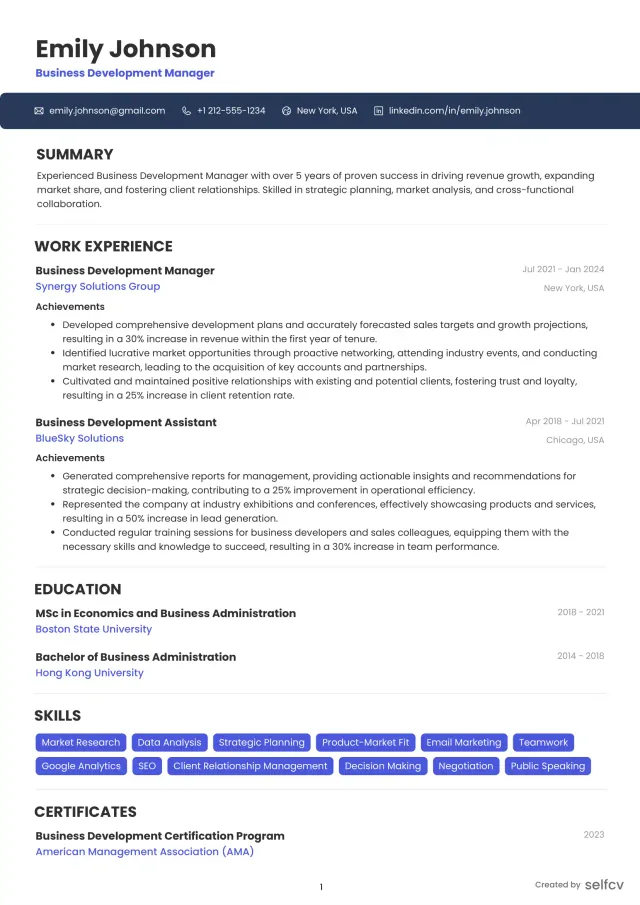
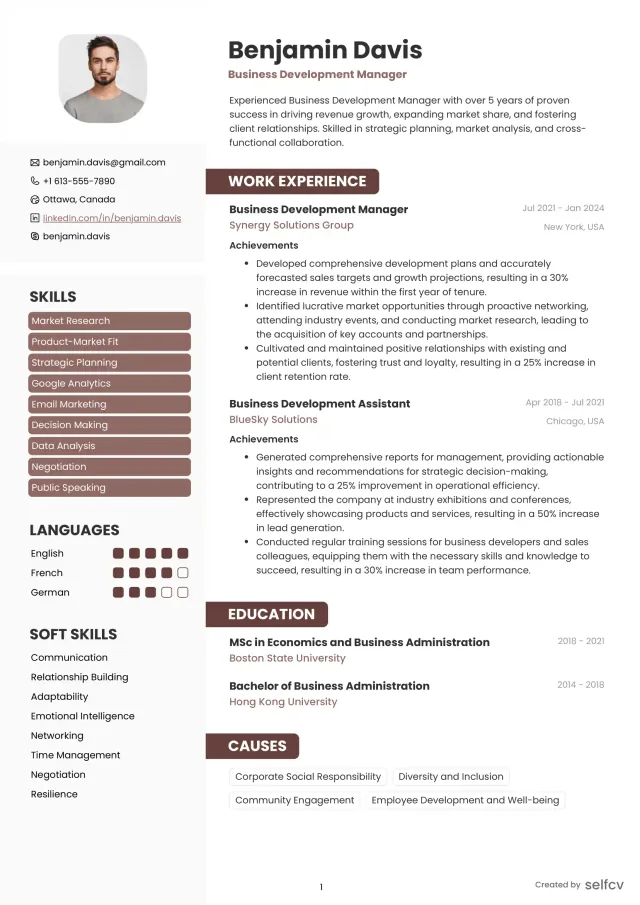
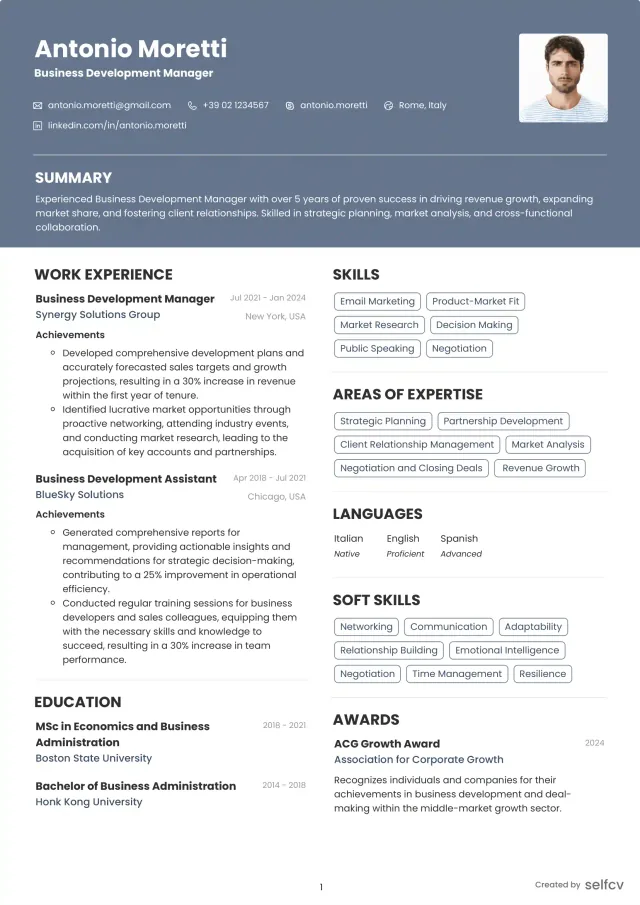
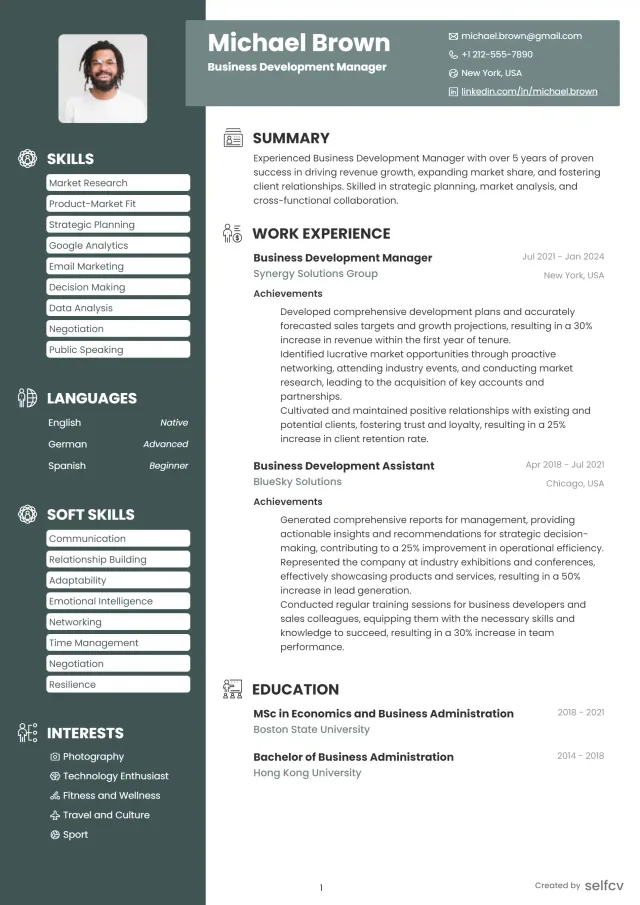
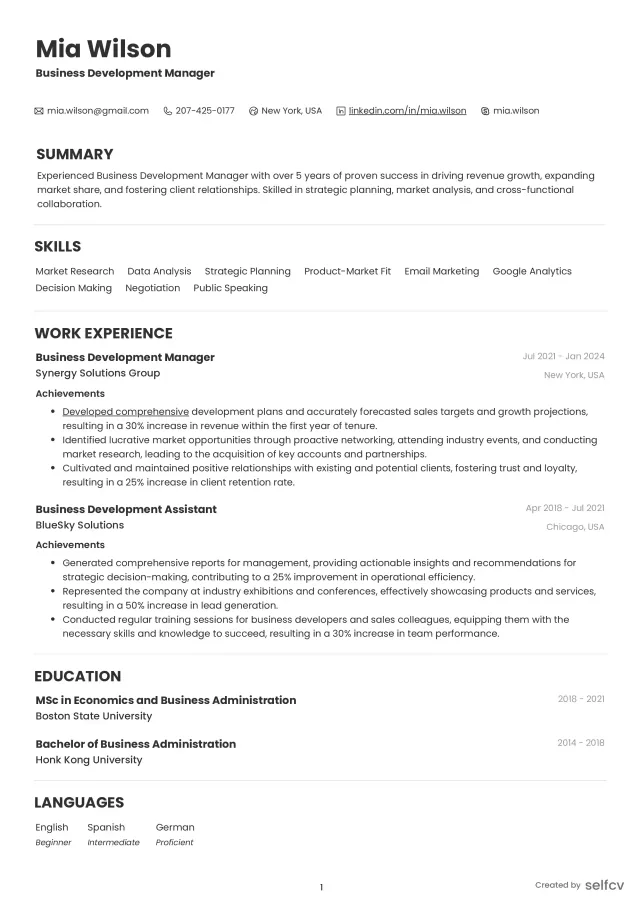
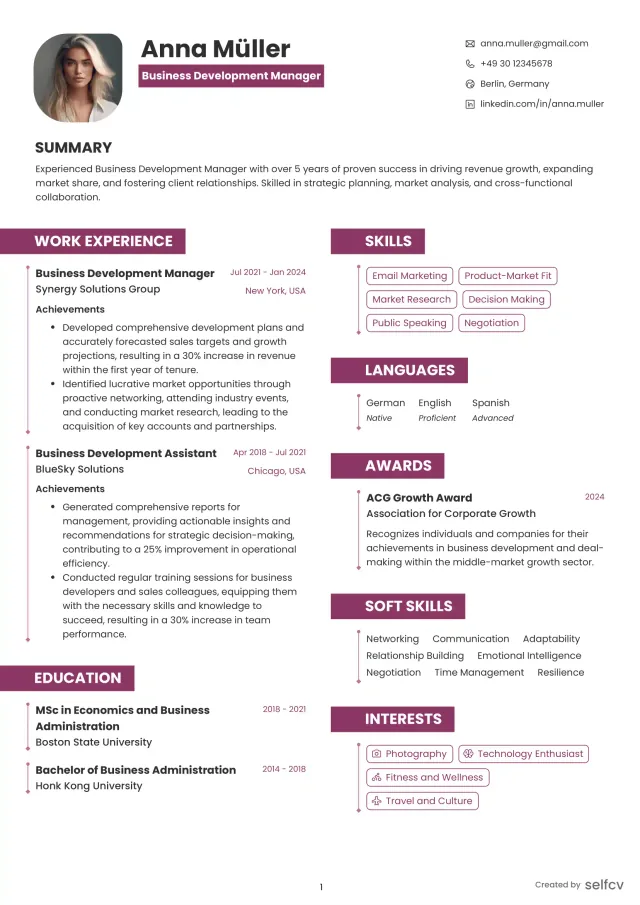
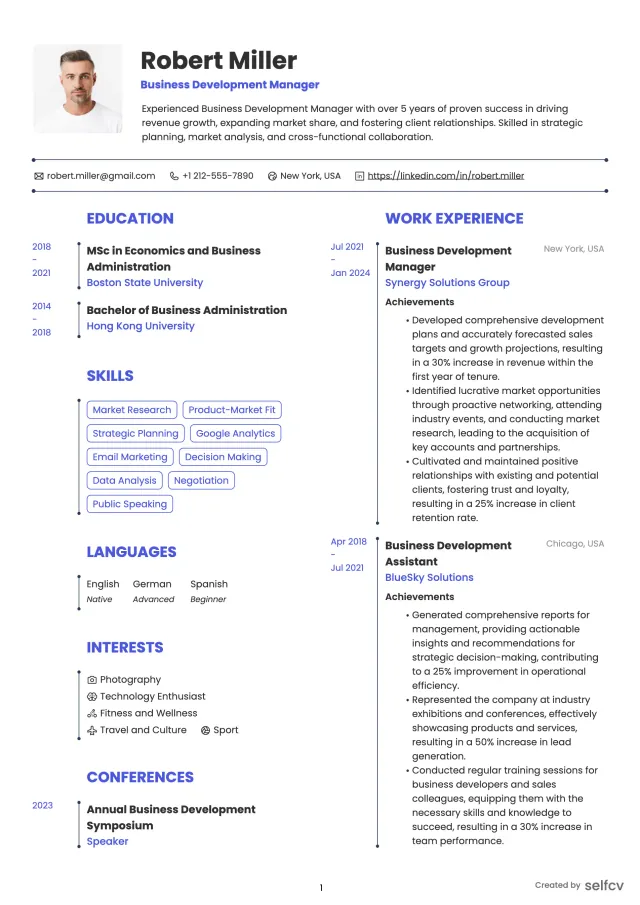
Complete fictional resume example
The candidate, companies, and career history shown are fictional examples created for illustration and any resemblance to a real person or organization is coincidental.
Maya Patel
Target Position
Senior Product Designer
Location
Toronto, Canada (open to remote)
Professional Summary
Senior product designer with 6 years building consumer fintech and mobile products. Combines quantitative A/B testing with qualitative research to improve onboarding, reduce churn, and scale design systems. Led cross-functional launches that improved activation and retention.
Grouped Skills
- Product strategy and experience design
- Interaction design, information architecture
- Prototyping (Figma, Framer), design systems
- UX research, usability testing, mixed-methods analysis
- Analytics and experimentation (Amplitude, Mixpanel, Google Optimize)
Professional Experience
Lead Product Designer, NovaBank (consumer fintech) 2022-2025
- Owned mobile onboarding redesign affecting 400k MAU, increasing activation by 21% through iterative prototypes and two A/B tests.
- Established a mobile-first design system and component library used by three product teams, reducing development time for new features by 30%.
- Partnered with PM and analytics to define OKRs and design experiments; authored 12 test hypotheses and led execution for top-funnel growth.
Product Designer, Helix Health (healthcare SaaS) 2019-2022
- Led care coordination workflows for clinicians, reducing task completion time by 18% through workflow simplification and microcopy updates.
- Ran mixed-methods research with 50 clinicians to prioritize features and validated improvements with pilot deployments.
Junior Product Designer, Pixel Labs (startup) 2017-2019
- Designed core components for the web app, shipped interactive prototypes, and reduced onboarding confusion by introducing progressive disclosure patterns.
Education / Training
- BFA Interaction Design, Ontario College of Art and Design, 2017
Certifications
- Google UX Design Certificate
- Interaction Design Foundation course: Mobile UX
- Optional: Certified Scrum Product Owner (CSPO)
Portfolio case-study callouts you can add to your resume
Each callout fits on one line and links to a full case study
- Mobile onboarding optimization: Reduced activation 21% - Case study: Mobile Onboarding (link)
- Design system rollout: Reduced handoff time 30% - Case study: Design System (link)
- Enterprise dashboard: Increased adoption 28% - Case study: Dashboard Redesign (link)
How to compress a case study into a resume bullet
- State the problem, your role, the key deliverable, and one metric.
- Example bullet: Led onboarding redesign (solo product designer) that reduced time-to-value 22% using 3 rounds of moderated testing and two A/B tests.
Check Your Resume with ATS
Make sure your resume passes Applicant Tracking Systems before recruiters see it.
- 📄 Upload your resume and get instant ATS feedback
- 🎯 Improve keyword matching for your target job
- ⚡ Boost your chances of getting shortlisted
Achievement examples: weak-to-strong
Example 1:
Weak:
- Improved onboarding
Strong:
- Redesigned onboarding flow for 150k monthly users, reducing time-to-first-value 22% via iterative prototypes and 150 moderated tests
Why it works:
- Adds scale, metric, methods, and timeframe so the impact is measurable and credible
Example 2:
Weak:
- Worked on the design system
Strong:
- Owned design system roadmap and delivered 45 reusable components that cut new feature implementation time 30% across three teams
Why it works:
- Replaces vague ownership with deliverables, scale, and business outcome
Example 3:
Weak:
- Conducted user research
Strong:
- Led mixed-methods research with 60 users that identified friction points; prioritized three product changes that increased retention 8% after implementation
Why it works:
- Shows sample size, decision impact, and measurable result
Tools, deliverables, metrics and evaluation criteria for product designers
Common tools and software
- Design and prototyping: Figma, Sketch, Framer, Principle
- Research and testing: UserTesting, Lookback, Maze
- Analytics and experimentation: Mixpanel, Amplitude, Google Analytics, Optimizely
- Handoff and dev tools: Zeplin, Storybook, GitHub integrations
Key deliverables hiring teams expect to see
- Wireframes, high-fidelity prototypes, design system components, interaction specs, user research syntheses, A/B test plans, and acceptance criteria
Stakeholders and work environment
- Cross-functional stakeholders: Product managers, engineers, data analysts, researchers, marketing, support
- Work environments: startup product teams, enterprise SaaS, consumer mobile, hardware collaboration with industrial design
Metrics to quantify
- Activation, retention, conversion rate, time-to-first-value, feature adoption, support ticket reduction, task completion time
Quality standards and compliance
- Accessibility standards (WCAG), privacy considerations for user research, platform guidelines (iOS, Android), medical or financial compliance when applicable
Specializations and projects
- Mobile-first design, design systems, research-led feature design, enterprise UX, hardware UI, accessibility-led projects
Hiring evaluation criteria
- Evidence of product thinking, measurable outcomes, clarity of decision-making, portfolio depth and relevance, collaboration and communication skills
Industry phrasing and resume tweaks by market
SaaS and enterprise
- Emphasize workflows, task completion metrics, scalability, and stakeholder coordination. Use terms like enterprise rollout, admin UX, seat-based adoption.
Consumer mobile and fintech
- Emphasize MAU/DAU, activation, retention, A/B tests, regulator compliance for fintech. Use terms like onboarding, conversion funnel, payment flows.
Healthcare and regulated industries
- Highlight accessibility, clinician workflows, data privacy, pilot deployments, and EHR integrations.
Consumer hardware
- Include collaboration with industrial designers, firmware constraints, hardware-software handoff, and usability testing with physical prototypes.
Consulting and agencies
- Demonstrate client-facing delivery, scoping, and cross-domain research synthesis. Use terms like discovery, deliverables, stakeholder workshops.
Formatting checklist and quick exports
Final formatting checklist
- One clear title line: the role you want
- Two-line summary that includes domain and impact
- 3-5 bullets per recent role with metrics where possible
- Portfolio link in header and in project bullets
- Grouped skill section using short labels
Export and filenames
- Save human-readable PDF for applications and plain text for ATS forms
- Filename: LastName_FirstName_ProductDesigner_2026.pdf
Accessibility and readability
- Use 10-12pt body text, sufficient white space, and bullet-friendly layout for quick scanning
Frequently asked questions (real search intent answers)
What should I include on a product designer resume in 2026?
- Include a clear role/title, a two-line impact summary, grouped skills, 2-3 recent roles with measurable bullets, and 2-4 portfolio case study links.
How do I show measurable product impact on my product designer resume?
- Add metrics, scale (users/regions/seats), timeframe, and your role in the outcome. If you ran experiments, mention the test and percentage uplift.
Where should I link my portfolio on a product design resume?
- Put a primary link in the header and add case-study links next to the relevant project bullets.
Which keywords do ATS systems look for in product designer resumes?
- product designer, UX designer, design system, prototyping, user research, Figma, mobile UX, A/B testing, product design portfolio
How does a senior product designer resume differ from a junior one?
- Senior resumes emphasize strategic ownership, cross-team impact, mentoring, and quantifiable business outcomes. Junior resumes focus on deliverables, learning curve, and project contributions.
How do I write a resume when transitioning from UX research to product design?
- Highlight research outcomes that led to product changes, add prototyping examples, and present hybrid bullets showing research insights paired with design decisions.
Related careers and adjacent roles
Related professions to include on applications and LinkedIn
- UX designer
- Product manager
- UX researcher
- Interaction designer
- Design systems engineer
- UX writer
- Mobile designer
- UI developer
Conclusion, checklist, and next steps
Conclusion
- A product designer resume in 2026 succeeds when it connects portfolio evidence to measurable product outcomes, uses ATS-friendly keywords, and clarifies ownership and scale.
Practical one-page checklist
- Role title and 2-line impact summary
- Portfolio link in header and in project bullets
- 3-5 outcome-focused bullets per recent role with metrics
- Grouped tools and skills that match target role
- Export as PDF and plain text for ATS when requested
Next actions
- Download a one-page and a multi-project resume template and a portfolio checklist to structure your case studies.
- Build an interview bullet bank from the strongest 6-8 achievements and rehearse the story for each.
- Consider specialization deep dives: design systems, research-led design, and mobile-first product design for role-focused applications.
seoTitle
Product Designer Resume Blueprint 2026: Turn Case Studies into Measurable Impact and ATS-Ready Keywords
metaDescription
Product designer resume guide for 2026 that converts case studies into measurable impact, optimizes ATS keywords, and links portfolio evidence across tech, SaaS, hardware and healthcare.
Why job seekers choose selfcv
Thousands of professionals use selfcv to build modern, ATS-friendly resumes, customize templates, and apply for jobs with confidence.
Thanks to SelfCV, I now have a professional and polished resume that I'm confident in sending to potential employers. I will definitely be recommending your service to other job seekers. Keep up the great work!
SelfCV offers an intuitive interface that makes creating a professional CV straightforward. Whether you're a student, a fresh graduate, or an experienced professional, the step-by-step process ensures that users of all levels can craft an impressive CV.
Easy to use resume builder. They have very intuitive ui for customizing and keeping multiple versions of resume.
The right tool for creating CVs. As a student I was looking for a tool that could help me quickly create a CV for internship applications. This was just the right tool. I am very satisfied!
This is one of the best tools I’ve ever used - I was able to build my CV in seconds with high quality template. Highly recommended!
Amazing app with easy user experience. Loved it. Its intuitive and easy to navigate, designs are very nice.
